Friday, August 18, 2017

Mark Bowie's Night Landscape Workshop — Cloudy Skies, Beautiful Imagery

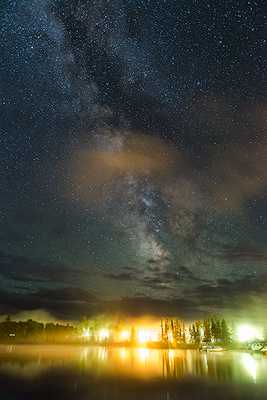
I’m continually amazed how various weather conditions can produce great night images.  Skies were mostly overcast each night of my Adirondack night landscape workshop this year.  The Milky Way made an appearance late one night, and a couple tireless students photographed it from about 3-4am.  The following night, we were photographing clouds over Fourth Lake, when one of my images (below) surprised me by registering the Big Dipper above the clouds.  We immediately went to a nearby lake, a darker setting with more open views, hoping to catch the Milky Way, but it was soon overrun by more clouds.


Though we had persistent cloud cover all four nights, we made some incredible images of the clouds reflected in area waters.  In the image below, the lights of local villages color the clouds, their arc reflected in a lake.  I framed some pickerelweed in the foreground, lit by a student's red headlamp.  The various elements of the scene came together amazingly well.  But here’s the most important thing I took away from this: you don’t get these conditions under clear skies.  It’s the clouds that really make the scene.  Next time, maybe I’ll better see the potential of overcast conditions, while still lamenting not seeing the Milky Way!


To me, night photography is an endless pursuit of heavenly beauty.  During each of my workshops, I take students out for some night shooting.  If you'd like to join me to explore the art of creating phenomenal images by the light of midnight, please see the API website and www.markbowie.com for upcoming events.

Thursday, August 17, 2017

Waterfalls Galore! Workshop to Photograph the Finger Lakes Falling Waters

Here in the Northeast, we're fortunate to have ready access to two of the foremost places in the country to photograph waterfalls: the Finger Lakes region of central New York, and Ricketts Glen State Park in north-central Pennsylvania.  API has been leading workshops to each for years and we often alternate between the two.  This year, API staff instructor Joe LeFevre and I led a group back to the Finger Lakes.  Based out of Ithaca, we visited a slew of great waterfalls, including Taughannock Falls, the highest in New York State.  We also visited several parks with trails leading beside numerous falls — Buttermilk, Fillmore Glen, Cascadilla Gorge — and found remarkable photographic possibilities in each.

Upper Pinnacle Falls, Fillmore Glen State Park

Joe and I have become renowned experts in waterfall and stream photography.  In addition to our guiding, we lead instructional sessions on the many nuances of shooting both types of flowing water, including experimenting with shutter speeds for a specific look and feel, the benefits of shooting in both overcast and sunny conditions, compositional opportunities presented by flowing water, and how to shoot and blend multiple exposures for layer masking, focus stacking, HDR's, and panoramas.  We specialize in the art of seeing flowing water and how to optimize the resulting images in processing.

Upper Falls, Taughannock Falls State Park

We're looking forward to hosting another waterfall workshop next year... in Ricketts, the Finger Lakes, or elsewhere.  We'll announce where on API's website later this year.  Let us know if you might like to join us and have a preference!


Thursday, July 6, 2017

Wild Coast Adventures ~ Bandon Beach & the Southern Oregon Coast Workshop

The southern Oregon coast features some of the wildest, most dramatic ocean scenery in the United States.  There are rugged peninsulas and secluded coves.  Sea stacks eroded from the rocky headland lie on the beaches and just offshore.  Storms lash it all and the light and scenery are constantly changing.  I teamed up with fellow API staff instructor Joe LeFevre to lead a group to Bandon Beach and points north and south, photographing a wide range of marine conditions.  The light was spectacular on our first four excursions.  At Meyers Beach we shot a colorful sunset over the many sea stacks.  At Otter Point sunrise fog encased the peninsula in angelic light.  Spiral-shaped clouds gathered over Samuel Boardman State Park at sunset on the second night, and fog suffused the sea stacks at Meyers the following morning.  Each was magical.


Sunset over sea stack and peninsula, Samuel Boardman State Park.

The look and feel of the West Coast is vastly different than the East Coast, and different photographic strategies are required to showcase the best of both.  Joe and I led instructional sessions with tips and techniques specific to shooting the coasts.  We covered reading weather and photographing diverse lighting situations, varying shutter speed to obtain different textures in the water, how to shoot waves for maximum impact, and shooting and blending multiple exposures to control a wide range of light, depth of field, and expand image resolution.

20-minute exposure of stars over Bandon Beach sea stacks.


This was the third workshop we've led to the West Coast and we're anxious to go back next year.  The scenery is so magnificent.  Watch the API website for our next workshop adventure out there.

Tuesday, March 28, 2017

2017 Adirondack Life Annual Photo Contest Winners


It's that time of year again when we get to see all of the beautiful photographs from the photo contest winners in the Annual Adirondack Life Photography Contest.


Congratulations to Richard Tyrseck for his stunning grand prize winning entry Misty Morning, Clear Pond.  Click the link below for details and to see all of the winners!

http://adirondacklifemag.com/photo/2017_Winners/photo2017.php

Rick is API Alumni and a wonderful photographer. He wins a spot in the Weekend with Adirondack Life workshop in Wilmington this September.  Get details about this great event hosted by three our of fabulous instructors here!

And congratulations also go out to all of the other winners!  There are always so many beautiful photographs!


Tim Goodrich (first-place landscape)
Spencer Morrissey (second-place landscape) 

Melanie Houck (first-place wildlife)
Pat McGuire (second-place wildlife) 
Sue Kiesel (third-place wildlife) API Alumni! 

Cassandra Blair (first-place people)
Robert Stone (second-place people)
Theresa Denney (third-place people)

Debbie Thacker (first-place Macro)
Ryan Nerp (second-place Macro)

Sue Bonacci (first-place B&W)
Daniel Hart (second-place B&W)
Dave Waite (third-place B&W)

Blaine Stauffer II (first place Recreation)

Editors Choice:
Emma Terry

Check out our 2017 schedule below.  You can also find us on Facebook!


Sunday, February 26, 2017

API's Winter Wonderland

The more I shoot winter the more I appreciate its many nuances of weather and light: how sunlight highlights wind-blown patterns on the snow.  How shadows turn rich blue and become graphic compositional tools.  How snow and ice react to the ever-changing temperatures.  And it's incredibly beautiful at night.  On cold winter nights, the stars seem to sizzle overhead.


To me, winter is most scenic in its extremes — big snows and heavy ice.  We were fortunate to find both.  Major snow storms, which dumped about two feet on the central Adirondacks, bookended our four-day workshop.  In a spruce and pine forest, we shot in snow up to our thighs.  On a -4 degree night we photographed the Big Dipper over Raquette Lake.  On the Moose River — which kept  flowing despite the cold — intricate ice formations clung to boulders.


This set looked like Christmas ornaments.  When converted to black & white, their intricate forms and textures jump out.


Our classroom sessions were devoted to the Art of Seeing winter, taking advantage of its many scenic and compositional opportunities.  We also covered shooting and blending multiple exposures as panoramas, HDR's, layer masks, and focus stacks — all to push the bounds of what's possible shooting the Adirondacks' incredible fourth season.  My heart-felt thanks to the participants, for their interest, passion, and creative spirit.  I very much enjoyed being with you.  Winter's not over yet and the possibilities continue to evolve as the weather changes.  Explore it while you can!

Monday, November 14, 2016

Peak Fall Colors, Peak Scenery

API wrapped up its 2016 offerings with our Peak Fall Color workshop, led by API staff instructor Johnathan Esper and myself.  In accordance with our philosophy to guide participants to different sections of the Adirondack Park, as each are so varied and distinctive, we based ourselves out of Long Lake for a few days, then made our way to the Schroon Lake area.  The Adirondack autumn put on colorful displays in both regions.  The reds were the best we've seen in years!  Near Tupper Lake, dwarf maples glowed pink and red in a marsh.  More vibrant foliage lined the Raquette River and its rocky tributaries.  Colorful trees overhung Palmer Pond, suffused to pastels by the rising fog.


For the first time ever, we were able to take participants to newly opened state land near Newcomb — a forest-lined pond with Kempshall Mountain rising majestically beyond.  We also received special permission to photograph in the privately-owned Elk Lake-Clear Pond Preserve, which has possibly the most dramatic vistas of mountains and water in the Adirondacks.  But maybe the highlight of our wanderings, was when Johnathan led us to open cliffs with views to the Great Range, where fall colors swept from alpine valleys up steep mountain slopes.


In the field and in the classroom we concentrated on the art of seeing, and tried to convey the essence of what we experienced and felt through our imagery.  The art of seeing is a life-long endeavor.  My goal is to keep learning, and to push the bounds of what can be captured with a camera.  Many thanks to all those who joined us in that pursuit this year.  I look forward to shooting with you again.  We're currently working on our 2017 schedule, and plan to post it soon.


API's Retreat — Special as Always

I've been privileged to help lead API's annual photographic Retreat since its inception nearly ten years ago.  And ever since John Radigan and I led that inaugural Retreat, it has been my favorite event of the year.  It has become our signature program, cherished by those fortunate enough to participate.  This year's Retreat was again truly special.  For six days we immersed ourselves in the craft of photography as we shot varied landscapes across the Adirondack's central lake country.


We photographed foggy sunrises in the Fulton Chain of Lakes and at Raquette Lake, brilliant fall foliage along Raquette River, and the night skies over the dark and mysterious Moss Lake.  Here the Milky Way rises bright as a cloud bank.  We made time lapse sequences of it as clouds and fog danced over the surface of the water — a majestic and awe-inspiring sight.


The Retreat is different from our workshops in several ways.  There are no formal instructional sessions; API staff instructor Joe LeFevre and I performed all activities as full participants.  Each day we were given assignments, wrote of our thoughts and experiences from the field, and presented them to the group.  We also worked towards presenting the theme of our week's work on the final day.  Sharing our experiences and the lessons learned is always emotional and inspiring.  Joe and I are grateful to the attendees for fully involving themselves in the process and helping make the Retreat the transformative event it is.

Watch for news of next year's Retreat coming soon.  We will continue the traditions that make this event so unique, while including some new learning sessions and shooting locations to keep it fresh.

Exploring Autumn with API & Adirondack Life

September and October are my favorite times to photograph the Adirondacks.  With mist and fog rising from the waters most mornings and the onset of fall colors, the photographic opportunities are magnificent.  API runs three successive workshops at this time of year, and they are amongst our most popular.  We kicked off the season by teaming up with Adirondack Life magazine for the Weekend with Adirondack Life workshop.  Fellow API staff instructor Johnathan Esper and I were joined by the magazine's art director, Kelly Hofschneider, for a behind-the-scenes look at how graphics professionals search for and use compelling landscape imagery.  Kelly's insights into publishing were invaluable.  Participants learned the types of images sought, the opportunities for getting their images and articles published, and how to submit them.

Outdoors, the Adirondack autumn produced again.  While much of New England had below-par fall colors, the Adirondacks displayed richly varied colors, with particularly strong reds.  They carpeted the mountainsides.


To change things up this year, we based out ourselves out of the Schroon Lake area.  Several iconic photo locales are nearby.  Local forests exhibit a mix of colorful hardwoods and evergreens.  We received special permission to photograph in the Elk Lake-Clear Pond Preserve.  At both Elk and Clear, fog swirled and danced over the water, against a backdrop of imposing mountains.


Along the dark shores of Putnam Pond we photographed the Milky Way towering overhead.  From the Belfry Mountain fire tower we caught a dramatic sunset over Giant Mountain and other High Peaks.  At Blue Ridge Falls dwindling water levels allowed us to shoot exposed potholes and other erosional features that are covered in spring and summer.  Thanks to our participants for their enthusiasm and willingness to explore with a camera.  They made truly special images at each of these places, and we all went home with a deeper appreciation for autumn in the North Country.


Wednesday, August 10, 2016

Photographing the Night Landscape Workshop - Stellar Again!

Though I've explored many facets of photographing the night landscape, I'm continually learning, continually being surprised by how beautiful it is.  My night workshop in the Adirondacks last week provided more stunning revelations.  I was joined by an intrepid group of shooters looking to learn the intricacies of the craft: how to determine exposures in a variety of situations, how to focus in the dark, how to deal with noise, and discover the possibilities for recording details in the nocturnal landscape and sky.

Night cabin, Inlet
The night weather was threatening but variable, presenting a slew of photographic opportunities.  It was overcast the first night, and again on the second night, until fog moved in late, then clouds above it parted to reveal the Milky Way towering over Raquette Lake.  The third night presented a mix of clouds and clear sky, and the Milky Way shining brightly.  And then a surprise... Perseid meteors — which don't peak until the following week — raining out of the northeast.  We saw and captured dozens!

Milky Way over Raquette Lake
I impressed upon the participants to go out night shooting with a few goals in mind, and they took it to heart.  We shot stars as points of light, as trails and as circles.  We shot meteors, planets, and our home galaxy — the Milky Way.  We made vertical & horizontal panoramas of it, and time lapse sequences of it cruising across the night sky.

Milky Way & Perseid Meteor
If you'd like to explore night photography consider joining us for any of our upcoming fall workshops; the night is so photogenic, we'll shoot it at each.  And of course, I'll run my night workshop again next summer.  See API's website for full program descriptions.  There's so much to shoot at night.  My goal is to keep exploring it, and finding ways to push the bounds of what's possible to capture under stellar dark skies.

Saturday, March 5, 2016

Adirondack Life Magazine Photo Contest Winners


It's that time of year again when we get to see all of the beautiful photographs from the photo contest winners in the Annual Adirondack Life Photography Contest


Congratulations to Adam Baker for his grand prize winning entry Foggy Fall Morning at Split Rock Falls.  Click the link below for details and to see all of the winners!

http://adirondacklifemag.com/photo/2016_Winners/photo2016.php

Adam wins a spot in the Weekend with Adirondack Life workshop in Schroon Lake this September.  Get details about this great event hosted by three our of fabulous instructors here!

And congratulations also go out to all of the other winners!  We are so proud to have 5 API Alumni on the winners list!


Richard L. Endres, Loudonville NY (first-place landscape)
Karl Fisher, Cary NC (second-place landscape) API Alumni!
Laura Castelein, Rochester NY (third-place landscape)

Philip Ashwood,Calcium NY (first-place wildlife) API Alumni!
Howard Arndt, Amherst (second-place wildlife) API Alumni! 
Pat McGuire, Washington DC (third-place wildlife)


Eric Thacke, Eatontown, NJ (first-place people)
Michael Fingar, Schenectady NY (second-place people)
Linda Benzon, Carlisle PA (third-place people)

Barb Drake, Bloomfield NY (Honorable Mention) API Alumni...there's a Drake every year!
Nicole Curtin, Long Lake NY (Honorable Mention)
Brad Wenskoski, Cohoes NY (Editors Choice)
Debra Apple, Schenectady NY (Honorable Mention) API Alumni!
Shawn Michener, Port Henry NY (Honorable Mention)

Check out our 2016 schedule below.  You can also find us on Facebook!


Tuesday, February 23, 2016

Mark Bowie's Finding November


Instructor Mark Bowie recently completed a self-assigned project to photograph November, staying close to home in western New England and northern New York State.  He was out nearly every day — anytime from predawn to night — making images and recording his impressions.  His goal was to look beyond the bare trees and gray skies to discover November’s hidden beauty.  It became a very personal project, an exercise in the art of seeing and expanding his craft.  And day after day, image after image found him.

He’s published the resulting images, and the stories behind them, in a new e-book — Finding November.  It's for anyone who appreciates the beauty of nature, whether you’re a photographer or not, and in particular, those who love the Northeast.  The collection reveals the depth and character of the month, and the treasures to be found by looking deeper.

 
Click on this link to learn more.


Tuesday, February 16, 2016

Working Winter's Opportunities


The central Adirondacks had received feet of lake effect snow this winter, but a warming trend a couple of days before our annual winter workshop had melted it from the trees and reduced the snow on the ground to a few inches.  Still, the lakes and ponds were covered with upwards of 12 inches of ice.  I've learned that different weather conditions create photographic opportunities that aren't available otherwise.  It's one of the major points I stressed as I went into great detail on strategies, tips and techniques specific to photographing winter under varying conditions.  I covered how to shoot big snows, extreme ice and blowing snow.  And I discussed shooting winter throughout the day and into the night — a wide variety of field craft and processing information participants could use the rest of the winter at home and in their travels.


Each time we ventured out we found something worthy of photographing.  Now the rivers and streams were open and spectacular ice formations along the banks were revealed. We were also fortunate to have three starry nights, despite forecasts for poor stargazing conditions over our entire stay (I've learned not to let weather forecasts psych you out of your plans here).  The Milky Way — even with much of the ecliptic below the horizon —arched brightly over the blue ice of Fourth and Moss Lakes. Venus, Jupiter, Mars and Saturn shone brightly. Several meteors streaked by. Shooting the Adirondack winter at night is truly an unforgettable experience.


Many thanks to the hearty photographers who join me.  I'm inspired by your creativity and enthusiasm, and we all came away with a renewed appreciation for winter in the North Country. I look forward to being with you again soon.

Mark Bowie


Tuesday, September 29, 2015

Inspiring Time-lapse Workshop!


Milky Way over Upper Browns Tract Pond

Imagine the Milky Way in all its glory moving across the night sky.  This was our backdrop for my second time-lapse workshop in the Adirondacks, and it proved to be an inspiring time for all.  The first two nights were clear so we took advantage of it to shoot the Milky Way until early hours of the morning.  We then spent the late morning and early afternoon processing images at the conference center of the Woods Inn in Inlet, NY.  I’ll never forget the look of joy on one participant’s face after he produced his first time-lapse movie of the Milky Way!

In addition to night shooting, we also photographed the sunset, making memorable time-lapse movies of colored clouds moving across the sky as the sun went down.  Thanks to all the participants whose camaraderie made this workshop a wonderful time for all.  Please consider joining me in 2016 for a great learning experience with time-lapse photography.

Joe LeFevre

Tuesday, August 18, 2015

Stellar Night Workshop!

A brilliant Milky Way, billions of stars, hundreds of streaking meteors, and northern lights — an utterly amazing celestial show in the dark skies over the central Adirondacks during my annual night photography workshop.  We all went away awestruck.  I'm still counting the meteors captured in my images!

Milky Way standing on end.  ©Mark Bowie 2015.

This is an in-depth and comprehensive workshop.  During indoor instructional sessions I covered the latest techniques for shooting the night sky in relation to the landscape, with recommendations for shooting the moon, stars, planets, meteors and other celestial objects.  I discussed shooting both wild landscapes as well as artificially lit scenes.  Many thanks to the enthusiastic group of shooters who joined me.  Their commeraderie and creativity were infectious.  And the night shooting was a blast!  We had clear skies on the first night, cloudy conditions on the second and third.  The forecast called for persistent clouds until around midnight on our final night, with clearing afterwards.  We were determined to stay up late, and we were rewarded.  Around 11:30pm the clouds drifted away to unveil the Milky Way shining brightly.  Over the next two hours, we counted about a hundred Perseid meteors streaming out of the northeast and along the axis of the galaxy.  It was a spectacular natural fireworks display!

A Perseid meteor over Fourth Lake.  ©Mark Bowie 2015.


Light trails & lit trees, Inlet.  ©Mark Bowie 2015.

This event sold out quickly, with a lengthy waiting list.  I'm honored by the support.  If you're interested in joining me for next summer's Adirondack night workshop, once the schedule is announced later this year, consider registering as soon as possible.  With enough interest, we'll look at adding a second night workshop.  And I'll continue to share the unbounded beauty, awe and wonder of photographing the Adirondacks by the Light of Midnight!

Mark Bowie

Milky Way & Perseid meteor.   ©Mark Bowie 2015.


Monday, June 29, 2015

3-in-1..... Spectacular Olympic National Park

With towering glacially-sculpted mountains that seem to rise straight up out of the ground, temperate rain forests housing the largest biomass on Earth, and wild and rugged coastlines, Olympic is like three national parks in one.  All this diversity within a few miles.  It's unparalleled.

Joe LeFevre and I led a six-day workshop to the region, scheduled around a new moon to take advantage of Olympic's dark skies. On clear nights the Milky Way shone brightly above the serrated edges of Sitka spruce.  We photographed stars circling over jagged peaks, with the Strait of Juan de Fuca and the lights of Victoria, British Columbia in the distance.

Sunset from Hurricane Ridge overlook. ©Mark Bowie 2015
We also visited the lush forests of the Solduc River Valley, perhaps my favorite forest anywhere.  Giant spruce, pines, and red cedar climb the hillsides, many draped with hanging mosses.  Velvety green mosses cover boulders in small streams.  We shot golden reflections in the Solduc River, just upstream of Solduc Falls, which plunges through a dramatic chasm.  In the Hoh Rain Forest, our challenge was to make order out of the chaotic richness of Life.  Here plants seems to cover nearly each inch of forest floor.  Elk thrive here as well.  One participant counted thirty-two in one place!

Exploring the Hoh Rain Forest, Hall of Mosses trail. ©Mark Bowie 2015
The mountains and lush forests are impressive, but to me, Olympic's wild sea coasts are the most photogenic.  The motion of the ever-changing tides, the wind and waves that bring in fresh atmosphere, and the presence of numerous sea stacks on the beaches and just off-shore, provide an endless variety of subject matter, forms, textures and color palettes.  At sunset we practiced timing our shots of waves as they curled up on shore, then receded.  We shot time lapse sequences of clouds streaming overhead.  And on one magical evening on Ruby Beach, witnessed one of the most spectacular and long-lasting sunsets we had ever seen.  As twilight descended the beaches and sky turned blue.  Venus and Jupiter appeared, shining over the sea stacks.  They put on a show each night.  We shot into the night, as stars peered out from behind clouds, reflected on the sand beaches.  The possibilities here are astounding!

Early night at Second Beach. ©Mark Bowie 2015
We heartily thank those intrepid photographers who experienced this place with us.  And to all our workshop attendees, whether you've been with us for one workshop or several... thank you for your support.  We'll continue to bring you the latest field techniques and digital workflow information as we pursue our creative endeavors together, in wild places far afield, and at home in the beautiful Adirondacks.

Mark Bowie


Wednesday, June 3, 2015

So Many Waterfalls, So Much Beauty - Exploring Ricketts Glen

There are so many waterfalls on Ricketts Glen's Kitchen Creek — 22 of them over a 3-mile stretch, ranging from 10 - 100 feet high — it's hard to photograph them all well in a single workshop... but we tried!  Joe LeFevre and I led an intrepid group of shooters here over two full days.  We experienced a range of lighting conditions, from sunny and breezy to overcast and quiet.  And the falls put on a show.   When the sun was out, we learned how to capture the colorful reflections of spring foliage in the creek.  The reflections changed with our vantage point and the wide contrast range demanded shooting multiple exposures to blend later in processing.  When it was overcast, the lime-green forest surrounding the cascades made a magnificent backdrop.  The lighting was even and the forest glowed against brilliance of the falls.  So both conditions created special imaging opportunities.


During the indoor instructional sessions Joe and I covered many field and processing techniques specific to waterfall imagery, including blending multiple exposures for exposure latitude, expanding resolution and focus stacking.  We discussed the creative use of filters for lengthening shutter speeds and reducing glare.  And we illustrated the special conditions produced by flowing water that make photographing waterfalls so enticing.


The concentration and variety of Ricketts' waterfalls makes it one of the best places in the East to photograph falling water.  This was our third trip here and we were again overwhelmed by the sheer number and beauty of the falls.  They're seemingly around every bend of the trail.  So much beauty over such a short span.  We can't wait to return!

Thursday, February 12, 2015

Winners of the Adirondack Life 2015 Photo Contest


It's that time of year again when we get to see all of the beautiful photographs from the photo contest winners in the Annual Adirondack Life Photography Contest


Congratulations to Matt Champlin for his grand prize winning entry Green Island on Indian Lake which you can see by clicking the link below:


Matt wins a spot in the Weekend with Adirondack Life workshop in Lake Placid this September.  Get details about this great event hosted by three our of fabulous instructors here!

 And congratulations also go out to all of the other winners, some for the first time, and some repeats, including some of our own alumni!  We are so proud!

Linda Benzon, Carlisle PA (third-place recreation)
Russ Hartung, Morrisonville NY (first-place recreation)
Ronan Chris Murphy, Marina del Rey CA (first-place people)
Hobit Lafaye, Ithaca (second-place people)
Melanie Houck, Brant Lake (first-place wildlife)
Lee Drake, Bloomfield NY (third-place landscape)  Lee placed Second in Macro in 2013!
Timothy Behuniak, Latham (second-place recreation)
Wayne Jones, Gansevoort (second-place landscape)
John Seelbinder, Rochester (first-place landscape)
Anita Vigorito, Willsboro (third-place wildlife)
Howard Arndt, Amherst (second-place wildlife) Howard was the Grand Prize winner in 2013!

Check out our 2015 schedule below.  You can also find us on Facebook!


Friday, February 6, 2015

Adirondack Life Photography show at View


Coinciding with the release of the 2015 Adirondack Life Photography issue, View will partner with the magazine in presenting highlights from this years issue. Adirondack Life Photography: A Celebration of Iconic Images features iconic images of the Adirondack park from some of the area’s top photographers—including work by:

Nancie Battaglia
Mark Bowie
Eric Dresser
Anne Diggory                                                                                             
Erika Edgley
Johnathan Esper
Nathan Farb                                                                                                 
Lisa Godfrey
Carl Heilman II                                                                                             
Joe LeFevre                                                                                               
Barry Lobdell
Robert A. Lubeck
Ben Stechschulte

A special opening reception will be held Sunday March 1, 2015 from 1pm-4pm. For more information visit View's website.

Tuesday, September 2, 2014

Joe LeFevre's First Time-Lapse Workshop

The Time-Lapse Gang
For the first time, I led a four-day time-lapse workshop out of Inlet in the southwestern Adirondacks, working out of the historic Woods Inn. We created a variety of time-lapse sequences, from sunrise over Raquette Lake, to the Milky Way over Moss Lake.  Two nights were spent in a classic Adirondack setting: a lake with loons calling, fog swirling as the night progressed, and the amazing Milky Way moving across the sky.

We spent time in the conference center learning the ins and outs of how to shoot time-lapse, optimizing our images, and finally, producing the time-lapse movies. New friendships were made, shooting partners were established, and great fellowship with like-minded people was enjoyed by all.

Joe

Monday, August 11, 2014

Amazing Night Weather ~ Possibilities Beyond Starry Skies

Many photographers, especially those new to night photography, may think they need clear skies and a small moon to photograph the night.  Images of dark, star-filled skies, whether the stars are recorded as points of light or as long trails, are indeed awe-inspiring.

Milky Way over Moss Lake, Adirondacks.
30 sec’s, f/2.8, ISO 5000

But there’s also incredible beauty to be discovered under varying meteorological conditions at night.  I take my camera out in all kinds of nocturnal weather: partly cloudy, foggy, rainy, in lightning storms and snow squalls.  It’s a chance to expand my repertoire and create unique images packed with drama and atmosphere.  I’ve seen moonlight catch fog on fire, cast rainbows on sheets of rain, and paint fogbows on mist.  I’ve recorded fingers of lightning fanning through cumulonimbus, and the Aurora Borealis backlighting clouds with fanciful colors.

Northern lights over Fourth Lake, Adirondacks.
12 min’s, f/4, ISO 400

Prior to night shooting, I check weather forecasts on-line.  Wunderground.com, weather.com, and noaa.gov provide hourly forecasts of sky conditions.  AccuWeather.com has an Astronomy tab that lists stargazing conditions over several nights, by location, based on the amount of cloudcover and phase of the moon.  I get excited when forecasts call for intermittent clouds.  Just as with daytime photography, at night clouds can lead to more interesting images.  They take on the colors of the atmosphere and reflect artificial lights from below.  When clouds are sufficiently thin, or there’re breaks in them, the stars and moon shine through.  Moving clouds streak through the sky during long exposures.  They splay dramatically when they’re coming at you or going directly away from you.  Using a wide angle lens will accentuate the effect.

Moon reflected in Little Tupper Lake, Adirondacks
30 sec’s, f/4, ISO 400

Even total cloudcover can be photogenic at night.  I was leading a night photography workshop to Newport, Rhode Island.  We gathered at a nearby beach where I gave a short session on nighttime camera settings as we stood under umbrellas in a torrential downpour.  Several members looked as if we should pack it in.  But we stuck it out and were rewarded.  In the fifteen minutes it took to drive to Newport Harbor, the rain stopped.  Clouds hung low over the world-famous sailing mecca, colored by the city lights.  I made this image, one of my all-time favorite night images.  Note how the lights paint the clouds in contrasting cool and warm tones, and how the long exposure has smoothed the clouds and water, and softened their colors to pastels.

Newport Bay Bridge and sailing vessels, Newport, RI.
30 sec’s, f/5.6, ISO 200

Night fog lends a certain cinematic atmosphere.  I experienced some amazing fog at Fourth Lake in the central Adirondacks.  On a summer night it streamed down a hillside, splayed out across the lake, and billowed up against the far shore.  The lights of a dock and gazebo colored it.  The Big Dipper shone above.

Fog on Fourth Lake, Adirondacks
30 sec’s, f/2.8, ISO 800

I led a workshop to Nauset Light on Cape Cod one spring night.  Skies were clear but for a layer of fog that hung over the top of the lighthouse.  The light rotated through the fog and I made this image, reminiscent of a Thomas Kincade painting.

Fog and stars over Nauset Light, Cape Cod.
30 sec’s, f/2.8, ISO 800

At Follensby Clear Pond in the Adirondacks an advancing thunderstorm was overtaking a starry sky.  Along the leading edge a night rainbow appeared, cast not by sunlight but by moonlight, as the moon rose behind me.  Sheets of rain fell beneath the stars.  You can’t make such images under clear conditions!

Stars and a moonbow, Follensby Clear Pond, Adirondacks
8 sec’s, f/2.8, ISO 3200

In Pittsfield, Massachusetts I shot a time-lapse sequence of a summer thunderstorm over Silver Lake.  Using a hahnel Giga T Pro wireless remote with a built-in intervalometer, I shot 10-second exposures, separated by one second, over about 35 minutes.  Many of the images didn’t capture lightning bolts, but several did.  In StarStax image stacking software I blended four images that contained bolts using Lighten blend mode.  The software combined the brightest parts of each image — the lightning bolts and lit clouds — to render this composite.  Be extremely cautious photographing thunderstorms.  Lightning can strike up to five miles out from a storm cell.  I feel relatively safe shooting receding storms with the wireless remote while I take shelter in my vehicle.

4-image composite of lightning over Silver Lake, Pittsfield, MA
Each exposure: 10 sec’s, f/2.8, ISO 200

The most astounding nocturnal weather event I’ve witnessed took place at Moss Lake in the Adirondacks on a cool summer night.  As the night progressed, a low-lying fog thickened over the lake.  The Milky Way towered above.  Eventually the half moon rose behind me, magically projecting a multi-colored moonbow on the fog, the shadows of bare shoreline trees beneath it.  What special conditions coalescing at once!

Milky Way and fogbow over Moss Lake, Adirondacks
30 sec’s, f/2.8, ISO 5000

So don’t limit your night shooting to clear skies; venture out in all kinds of weather and explore the artistic possibilities.  You’ll find that as beautiful as the resulting images may be, the ultimate reward is discovering the majesty of Nature at work after dark.


Mark Bowie has authored two extensive e-books on night photography: The Light of Midnight and After Midnight.  They are available through his website: www.markbowie.com.  He is a staff instructor with API and leads photo workshops, tours and seminars throughout the year.  He is also a much sought after public speaker.  For a list of upcoming API events, visit www.adkpi.org.

Special thanks to Hunt's Photo for granting API permission to re-produce this feature, which originally appeared on their blog.